Telephoto Las Vegas, NV
Las Vegas Skyline at Dawn
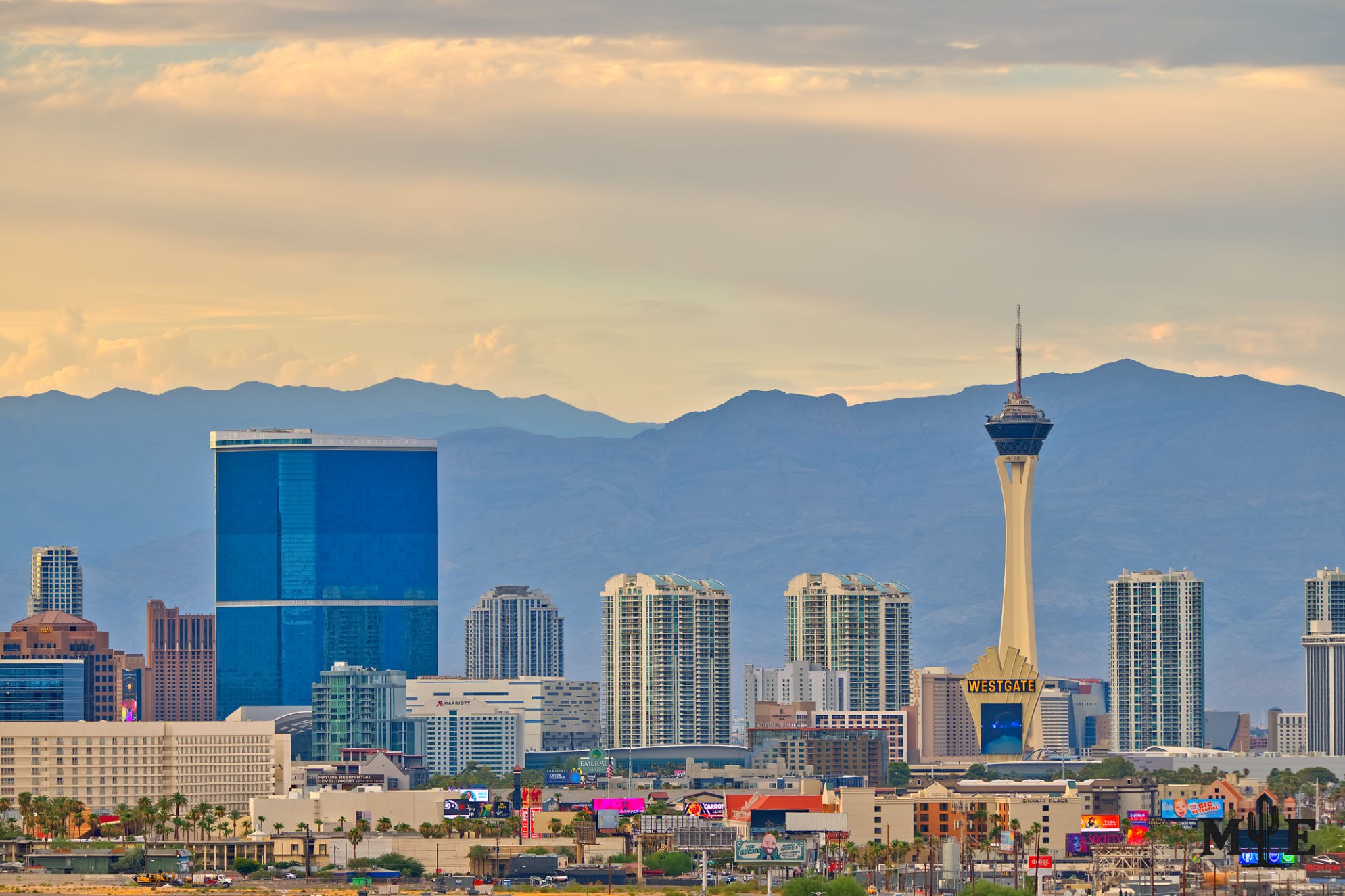
When individual towers are visible before signs, traffic and artificial illumination take over the scene. This photograph however captures the resort corridor in golden-blue morning light from an unusual southeastern angle. At dawn, the Las Vegas skyline looks less like a wall of neon and more like a city suspended between desert and sky. The mountains remain present behind the buildings, reminding the viewer that the skyline occupies a broad Mojave Desert basin rather than an isolated entertainment district.
Las Vegas does not have one compact downtown skyline in the traditional sense. Its most familiar towers are distributed along several miles of Las Vegas Boulevard, while the historic downtown hotel district stands farther north. From ground level, those areas feel separated by long blocks and major roads. A telephoto lens changes that relationship. Distance is visually compressed, allowing towers built miles apart to appear stacked together and creating a denser skyline than a person would experience while traveling along the Strip.
That compression also reveals how the city has evolved. Older landmarks share the horizon with newer glass towers, hotel additions and high-rise residential buildings. The STRAT acts as a northern marker, while the larger resort towers trace the Strip southward through the valley. Depending on the viewpoint, buildings that normally dominate street-level photographs may partly disappear behind less familiar structures. That's what makes an off-axis skyline photograph valuable: it replaces the standard postcard alignment with a view that explains the city’s actual depth.
The early hour matters. Near sunrise, sunlight travels through more of the atmosphere and produces warm gold along the horizon while the upper sky retains cooler blue tones. The balance lasts only briefly. As the sun rises, the buildings become brighter, shadows shorten and the atmosphere begins to lose the soft separation visible here. Early morning can also provide clearer telephoto conditions than a hot afternoon, when rising air over pavement and desert ground creates shimmer that distorts detail and makes distant architecture appear fuzzy.
Haze is still part of the Las Vegas view. Dust, humidity, wildfire smoke and ordinary urban particles can soften distant buildings or separate the skyline into layers. In an early morning photograph, atmospheric anomolies don't have as much of an impact. Regardless, early morning light and calmer weather conditions give structures greater contrast while the farther towers and mountains usually recede gradually into the background.
Portions of similar skyline imagery also illustrates a geographic detail that surprises many visitors: most of the Las Vegas Strip is not within the incorporated City of Las Vegas. Major resorts occupy unincorporated Clark County communities such as Paradise and Winchester, while downtown belongs to the city itself. The skyline functions as one metropolitan symbol even though it crosses governmental boundaries and several distinct districts.
Seen from this direction, Las Vegas is not only a collection of recognizable hotels. It's a long urban corridor shaped by distance, elevation, desert atmosphere and mountain boundaries. The golden-blue sky gives the city a quieter identity than its nighttime reputation suggests. For a few minutes after daybreak, the skyline is defined less by spectacle than by structure: towers aligned across a basin, light moving over glass and a city gradually becoming visible.
Prints, Artwork and Licensing
This photograph is available for project-specific review as finished wall artwork and for appropriate editorial, commercial, hospitality, corporate, healthcare, or civic licensing. Final dimensions, cropping, materials, usage, production, and installation requirements are confirmed for each project.
Use the inquiry button above and reference ME-00414 so the exact image can be identified quickly.


