Las Vegas Nevada Red Rock Canyon National Conservation Area
Why Red Rock Canyon is Red
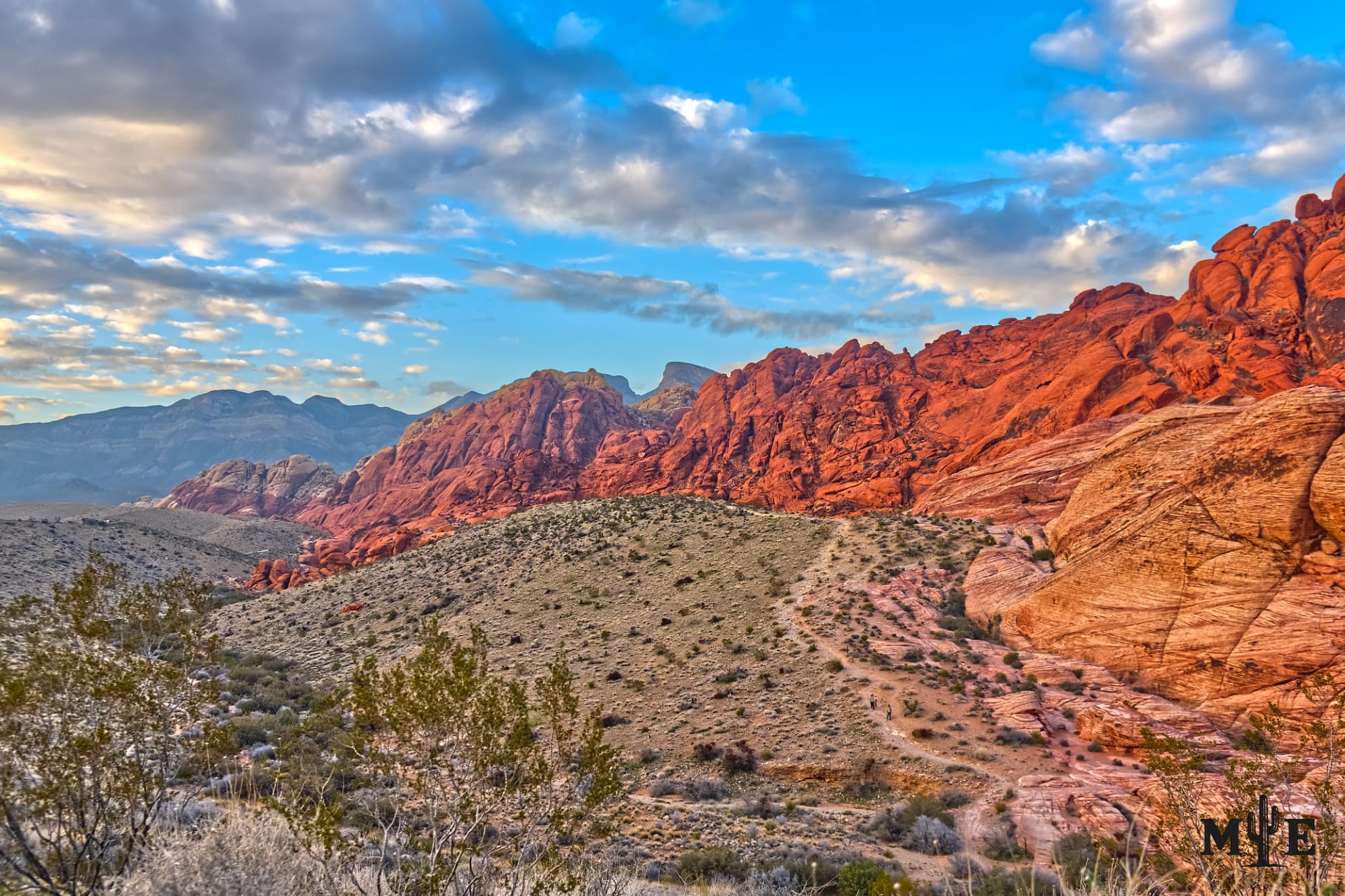
The simplest explanation is that Red Rock Canyon is red because the sandstone contains iron that reacted with oxygen—essentially rusting inside the rock. That natural rust created the red, orange and pink colors seen across the cliffs. The process happened slowly over millions of years.
About 180 million years ago, during the Jurassic Period, this part of the Southwest looked very different. It was covered by an enormous desert filled with shifting sand dunes. Wind moved the dunes from place to place, building them into sweeping hills and ridges. Over time, more layers of sand accumulated and eventually buried the older dunes.
As the sand became deeply buried, pressure and minerals carried by groundwater gradually hardened it into sandstone. The result is the formation now known as Aztec Sandstone, which can be seen throughout Red Rock Canyon and in other parts of the Southwest.
The iron already present in the sand gave the rock its famous color. When iron is exposed to oxygen and moisture, it forms iron oxide—the same basic process that causes metal to rust. Inside the developing sandstone, this reaction stained large sections of the rock red. In some places the color became dark crimson; in others it produced softer shades of orange, pink or gold.
The cliffs are red for essentially the same reason an old iron object turns reddish brown. The difference is that the process occurred naturally inside ancient sand deposits and continued over an almost unimaginable length of time.
Not every part of Red Rock Canyon is the same color because iron was not distributed evenly throughout the ancient dunes. Water also moved through the developing rock, changing or carrying away some of the iron. Where more iron remained and reacted with oxygen, the sandstone became strongly red. Where less iron was present—or where water altered it—the rock stayed tan, yellow, cream or nearly white.
That explains why one wall can contain several colors at once. A deep red section may sit beside golden sandstone, pale cream bands or almost white rock. The different shades do not necessarily represent completely different kinds of stone. They often reflect how much iron was present and what happened to it while the sandstone was forming.
The curved and diagonal bands visible in many cliffs are also remnants of the ancient dunes. They show how the sand once sloped and shifted under changing winds. Visitors are not merely looking at red rock; they're looking at the preserved shape of a desert that existed during the dinosaur age.
The landscape became even more dramatic millions of years later, when powerful movements within the Earth pushed and lifted large sections of rock. Along the Keystone Thrust, older gray limestone was forced over younger red sandstone. This created one of Red Rock Canyon’s most striking contrasts: gray rock formed beneath an ancient sea positioned next to red rock formed from an ancient desert.
Wind, rain, flash floods and temperature changes later carved the uplifted formations into the cliffs, domes, canyons and ridges visible today. Water followed cracks and weaknesses in the stone, gradually opening larger channels. Pieces broke away, washes carried material downhill and harder sections remained standing as massive walls.
Weather continues to change the surface. Sunlight can make the red appear brighter or darker depending on the time of day. Wet sandstone often looks richer and more saturated after a storm. Early morning and late-afternoon light can intensify the oranges and reds, while midday light may make the same formation appear flatter or more pale. Dark streaks on some surfaces may come from later mineral coatings known as desert varnish rather than from the sandstone’s original red color.
This photograph shows that history in an immediately understandable way. The red sections contain more visible iron staining, while the gold and cream areas experienced different mineral conditions. The curved forms began as moving dunes, and the cliffs were revealed through uplift and erosion.
Red Rock Canyon is therefore red for a straightforward reason: an iron-rich ancient desert slowly hardened into stone, and the iron inside it rusted. What makes the place extraordinary is the scale of the result. A familiar chemical reaction transformed an immense field of sand into the glowing red walls that now define the western edge of Las Vegas.
Prints, Artwork and Licensing
This photograph is available for project-specific review as finished wall artwork and for appropriate editorial, commercial, hospitality, corporate, healthcare, or civic licensing. Final dimensions, cropping, materials, usage, production, and installation requirements are confirmed for each project.
Use the inquiry button above and reference ME-00385 so the exact image can be identified quickly.


