Red Rock Canyon Las Vegas
The Las Vegas Desert: Life, History and Extremes
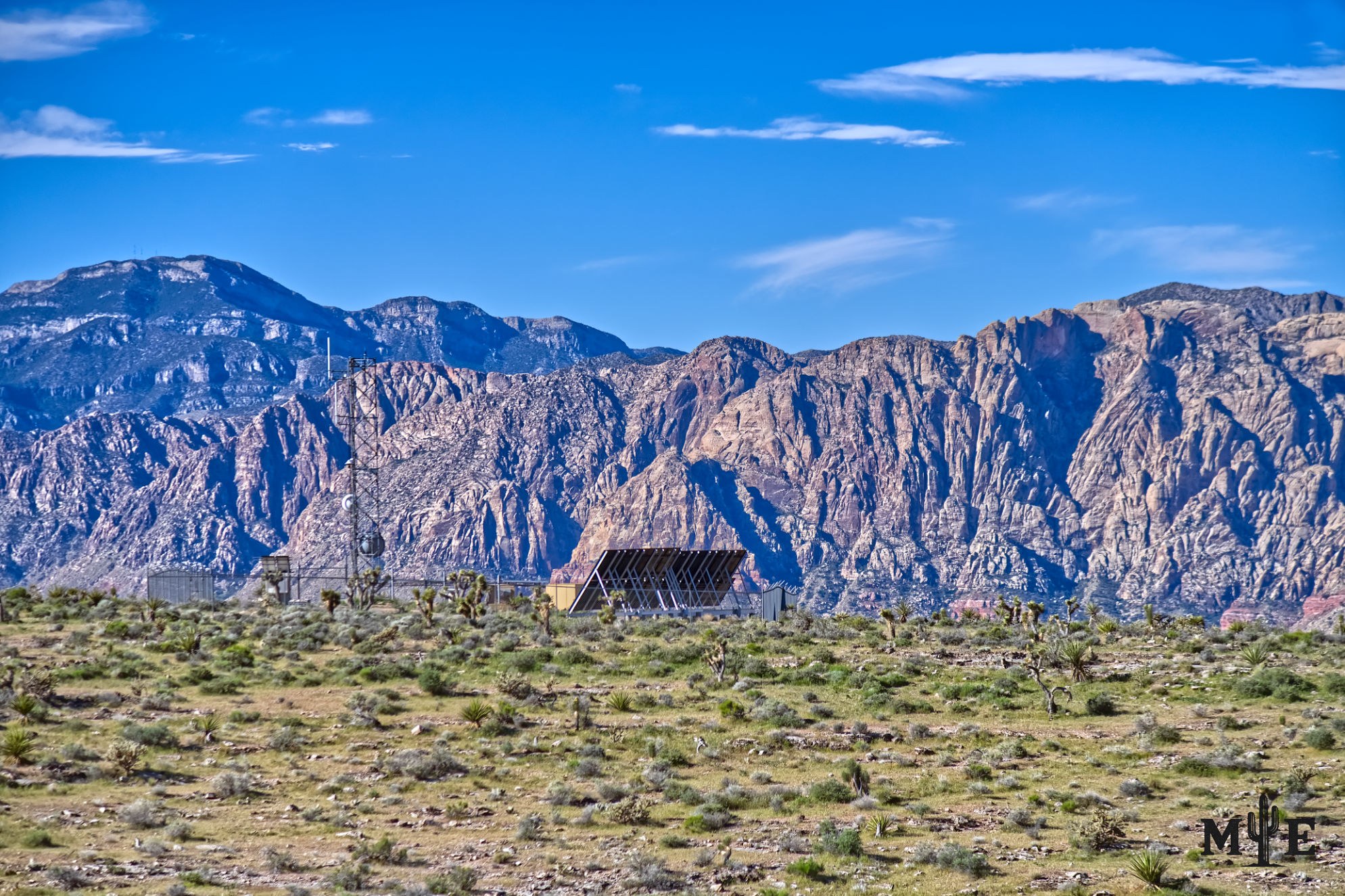
Las Vegas is often described as a city placed in an empty desert, but the landscape in this photograph is neither empty nor uniform. The panels and tower provide a strange modern marker; behind it, the Spring Mountains rise through ecological zones. The valley occupies the Mojave Desert, but elevation, geology and water create far more variety than the word suggests.
The environment is also less forgiving than its proximity to the city implies. The Bureau of Land Management states plainly that people are lost, injured or killed at Red Rock Canyon each year. Summer temperatures can exceed 110°F, mobile service can disappear, and dry washes can become dangerous during thunderstorms. A trail visible from a neighborhood can still become serious backcountry once the pavement drops out of sight.
Winter surprises visitors for the opposite reason. Typical Las Vegas winter days can be mild, but nights regularly fall into the 30s and occasionally the 20s or teens. The official city record low is 8°F, set in January 1963. The Spring Mountains are much colder than the valley and receive substantial snow; a clear road in Las Vegas can lead toward icy trails and full winter conditions at elevation.
Las Vegas reached 120°F on July 7, 2024, the highest official temperature in the city’s weather record. Rock, exposure, wind and elevation produce strong local differences. In summer, a late start can turn a moderate walk into an emergency.
The desert’s strangest discoveries are often prehistoric. Tule Springs Fossil Beds, on the northern edge of the Las Vegas Valley, preserves evidence of wetlands that existed intermittently from roughly 570,000 to 10,600 years ago. Fossils include mammoths, ancient camels and horses, bison, ground sloths, dire wolves, saber-toothed cats and lions. The modern dry wash is therefore only the latest phase of a landscape that once supported large Ice Age animals around springs and marshes.
Human history is equally deep. The Las Vegas Valley is the homeland of Southern Paiute people, who used its springs, plants, animals and seasonal routes long before Euro-American settlement. The valley’s water later made it an important stop on the Old Spanish Trail between New Mexico and California. Antonio Armijo’s 1829–30 journey helped establish the commercial route, and John C. Femont passed through during his western expeditions.
Spanish explorers did reach the broader region, but Las Vegas was not founded as a Spanish colonial town. Nor was it built around a major U.S. Cavalry post. The Old Las Vegas Mormon Fort, established in 1855 near the valley springs, was a missionary and settlement outpost. Military posts and Army activity existed elsewhere across the Southwest, but calling the Las Vegas fort a cavalry fort would be inaccurate.
The surrounding mountains contain valuable geology. Blue Diamond Hill is especially associated with gypsum mining, while limestone and dolomite are prominent in the region. Southern Nevada has a wider history of gold, silver and other mineral exploration, but the mountains immediately west of Las Vegas are not simply undiscovered vaults of precious metal. Their most visible commercial value has often been industrial minerals, construction material and, increasingly, protected scenery.
Wildlife survives surprisingly close to the urban edge. Desert tortoises, bighorn sheep, mule deer, coyotes, jackrabbits, rattlesnakes, scorpions and many birds occupy different habitats. Wild burros and horses are also seen around Red Rock and the Spring Mountains.
The communications equipment in the photograph are a reminder that this is not untouched wilderness. Communications sites, mines, utility corridors, roads and expanding neighborhoods share the view with ancient rock and protected habitat. That tension is part of what makes the Las Vegas desert unusual: millions of people live beside terrain where Ice Age fossils remain buried, Indigenous history is embedded in springs and trails, winter snow is visible above summer heat, and a wrong turn can still carry real consequences.
Prints, Artwork and Licensing
This photograph is available for project-specific review as finished wall artwork and for appropriate editorial, commercial, hospitality, corporate, healthcare, or civic licensing. Final dimensions, cropping, materials, usage, production, and installation requirements are confirmed for each project.
Use the inquiry button above and reference ME-00404 so the exact image can be identified quickly.


