Red Rock Canyon Las Vegas Red Rock Canyon National Conservation Area
Wild Burros of Red Rock Canyon
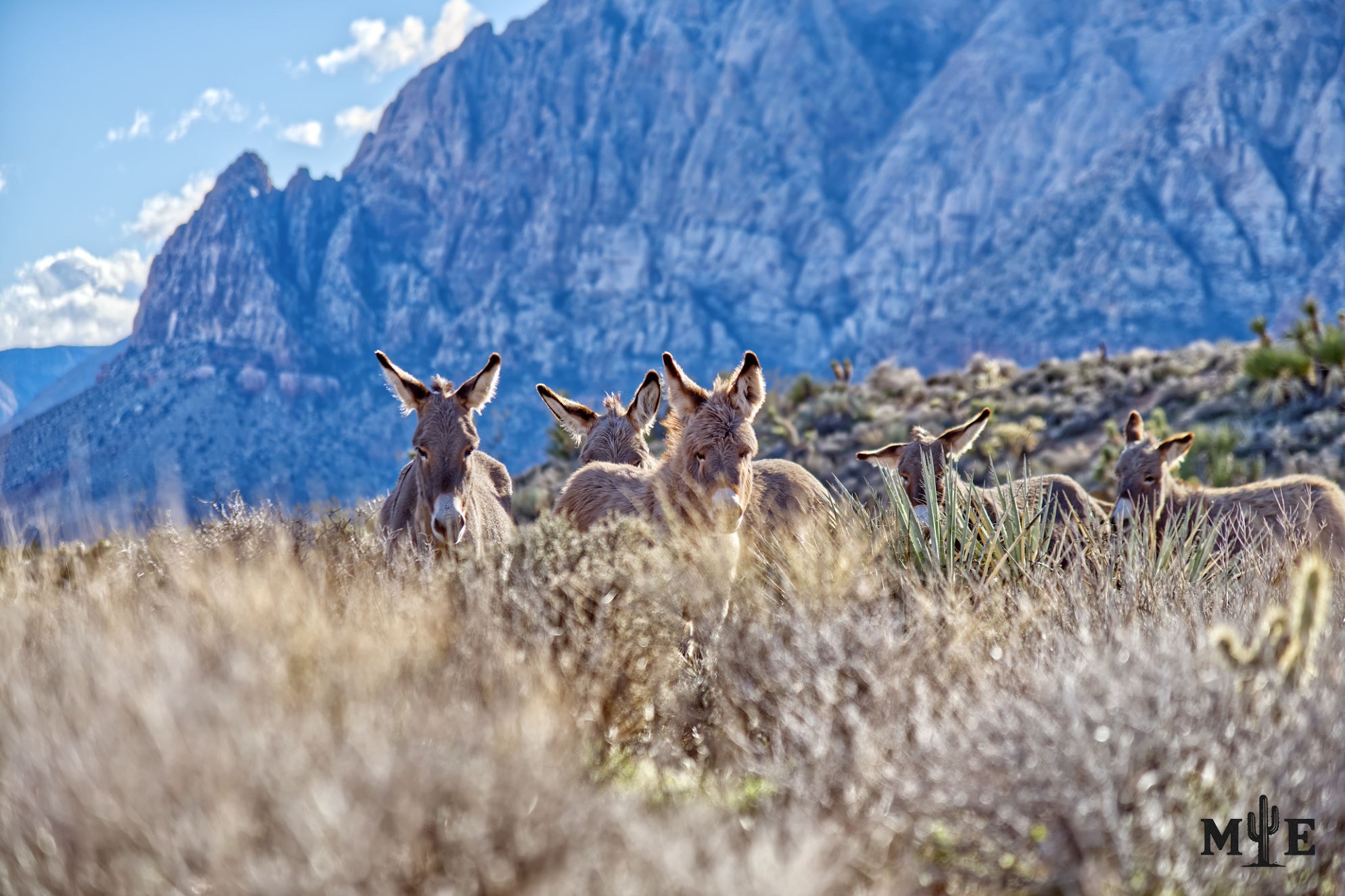
People often point at the animals near Red Rock Canyon and say, “Look at the donkeys.” They're not wrong. A burro is a donkey; “burro” is the Spanish word commonly used in the American West for free-roaming donkeys and their working ancestors. The name carries historical meaning, but it doesn't identify a separate species.
The burros in Red Rock Canyon Las Vegas did not originate as native desert wildlife. Their domesticated ancestors were working animals brought into the American West, where explorers, settlers and prospectors used horses and burros for transportation and carrying belongings. Burros were especially useful pack animals in rough, dry country that was difficult for wagons.
Mexican traders are part of the broader regional story, but the local explanation is more specific than “Mexican farmers.” The Bureau of Land Management identifies Red Rock Canyon’s wild burros as descendants of donkeys released by miners living in the area during the late nineteenth and early twentieth centuries. Prospectors used them to carry water, food, tools and ore where vehicles could not travel. As mining changed and motorized transport replaced pack animals, some burros were released or left behind and reproduced in the desert.
That history explains an apparent contradiction. Biologically, burros are non-native to the Mojave Desert. Culturally and legally, they're protected symbols of the American West. Congress passed the Wild Free-Roaming Horses and Burros Act in 1971, directing the Bureau of Land Management and U.S. Forest Service to protect and manage herds in areas where they were roaming when the law took effect.
Red Rock Canyon lies within a much larger herd-management landscape. The Red Rock Herd Management Area covers nearly 162,000 acres and has an official target of 29 to 49 wild burros, along with a smaller managed horse population. Actual numbers can rise well above what the BLM believes available water and vegetation can support. The agency uses fertility control and adoption programs to reduce pressure on springs, forage and other wildlife habitat. A 2026 operation across the larger Spring Mountains Complex removed hundreds of horses and burros after the BLM cited overpopulation, ecological damage and animals crossing highways.
Burros are especially visible along State Route 159 between Spring Mountain Ranch State Park and Blue Diamond, where springs and roadside vegetation attract them. That accessibility has made them local celebrities, but it's also created serious danger. A driver rounding a curve may encounter an animal standing in the lane after dark. Burros that are fed by visitors begin associating vehicles with food and may approach traffic instead of avoiding it.
The safest encounter is from inside a vehicle or from a substantial distance after pulling completely off the roadway in a legal area. Visitors should not feed, pet, corner or attempt to ride them. A calm-looking burro can bite, kick or move suddenly, especially when a foal is nearby. Feeding and harassment are illegal, and even well-intended contact can make the animal more likely to be struck by a car later.
Desert sustainability should not be mistaken for invulnerability. Burros still need dependable water and enough forage, and prolonged drought can place a herd in poor condition. Their numbers can also grow faster than arid land recovers. This is why burro management produces strong emotions: people love seeing them, while land managers must account for a non-native population sharing limited desert resources.
The animals in this photograph are therefore more than “wild donkeys.” They're living remnants of mining, transportation and settlement across the Southwest. Their local ancestors carried the equipment that helped people work these mountains, then outlived the industries that brought them here. Standing beneath the Spring Mountains, they appear perfectly native to the scene. Historically they belong to its human story; ecologically, their presence remains complicated. Both truths are necessary to understand the burros of Red Rock Canyon.
Prints, Artwork and Licensing
This photograph is available for project-specific review as finished wall artwork and for appropriate editorial, commercial, hospitality, corporate, healthcare, or civic licensing. Final dimensions, cropping, materials, usage, production, and installation requirements are confirmed for each project.
Use the inquiry button above and reference ME-00250 so the exact image can be identified quickly.


