Las Vegas Nevada
The Pyramid of the Strip: Luxor Las Vegas
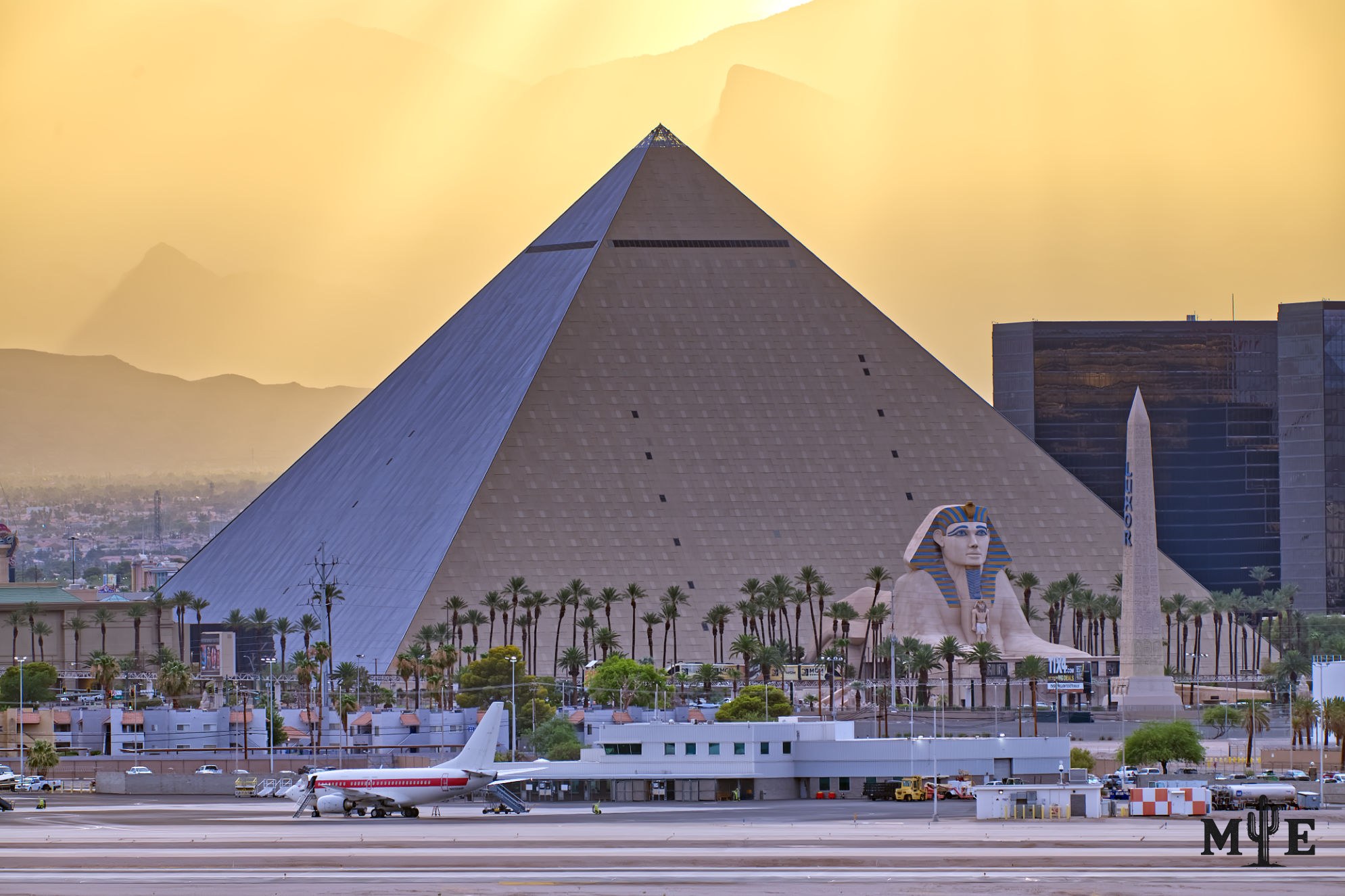
The Luxor Hotel is the kind of building that makes a reasonable person ask how it was ever approved. A black-glass pyramid, an enormous sphinx and a beam aimed into the night sky sound more like a rejected movie set than a working hotel. Yet that was exactly the point. In the early 1990s, Las Vegas resorts were competing through architecture that could be recognized instantly from a freeway, an airplane or a television screen.
Luxor was developed by Circus Circus Enterprises, the company later known as Mandalay Resort Group. Architect Veldon Simpson designed the pyramid, while Yates-Silverman developed the original interiors and traveled to Egypt to study the theme. The resort was announced in 1991, construction began in 1992 and opened in October 1993. Contemporary reporting described inclined elevators rising along the pyramid at roughly a 39-degree angle and an interior packed with Egyptian references, entertainment technology and family-oriented spectacle.
Those elevators—usually called “inclinators”—and the vast central atrium help explain reports of dizziness. Some guests find the angled motion unfamiliar, and upper-level walkways look into an immense open volume. People who are sensitive to heights, visual motion or vertigo can feel uncomfortable. There is no evidence that Luxor causes a widespread medical problem, however. Most guests use the inclinators without incident, and a room in one of the later tower additions avoids much of the pyramid’s unusual circulation.
The Egyptian imagery produces equally divided reactions. The exterior sphinx, obelisk and statues are not trying to pass as archaeological originals. They're monumental entertainment architecture made for Las Vegas, where scale and instant recognition matter more than museum. Some visitors see the figures as wonderfully theatrical; others call them dated or hokey. Both reactions are reasonable. Luxor has reduced portions of its original theme over the decades, but removing the recognizable exterior would erase the property’s greatest asset.
Inside, the resort is more than an unusual shell. Current entertainment includes Blue Man Group, comedian Carrot Top and the long-running adult revue FANTASY. Visitors can also find Titanic: The Artifact Exhibition, Bodies: The Exhibition, an esports arena and newer interactive entertainment. The casino, pool complex, restaurants and connection to neighboring Excalibur and Mandalay Bay make Luxor a practical south-Strip base even for guests who are not deeply interested in Egypt.
The Sky Beam remains the resort’s most persistent legend. The original system focused light from 39 xenon lamps, each rated at 7,000 watts, through curved mirrors at the pyramid’s tip. At full output it was commonly rated at 42.3 billion candela. Since 2008, only part of the original lamp array has generally been operated to reduce energy and maintenance costs.
Can it be seen from 275 miles away? Under exceptionally clear conditions, pilots at cruising altitude have reported seeing the beam or its glow from great distances, including the Los Angeles region. That's not the same as a person standing 275 miles away and seeing a crisp white column rising from Las Vegas. Visibility depends on altitude, darkness, atmospheric clarity and the viewing angle.
Can it be seen from space? Not in the way the tourism legend implies. The concentrated visible column reaches only a small fraction of the distance commonly used to define the edge of space. Satellites can detect artificial light and scientific instruments have detected the Luxor source, but that does not mean astronauts see a distinct beam shooting from the pyramid with the unaided eye. Las Vegas itself is conspicuous in nighttime satellite imagery; the specific “visible from space” claim is mostly promotional mythology.
Luxor succeeds because the mythology is inseparable from the building. Its rooms and attractions have changed, its Egyptian theme has been edited, and newer resorts offer more contemporary luxury. The pyramid still does what Simpson intended: it functions as a giant sign. Even among the towers of the Strip, no caption is required to identify it.
Prints, Artwork and Licensing
This photograph is available for project-specific review as finished wall artwork and for appropriate editorial, commercial, hospitality, corporate, healthcare, or civic licensing. Final dimensions, cropping, materials, usage, production, and installation requirements are confirmed for each project.
Use the inquiry button above and reference ME-00406 so the exact image can be identified quickly.


